Showing posts with label Dark Green Fritillary. Show all posts

Monday, 19 July 2021

Silver-studded Blue


Time to catch up on some of the late season butterflies and also a few of the earlier ones that I had not recorded. This sudden return of enthusiasm being triggered by the hot weather and the realisation that I was about to time out on the Silver-studded Blue.

It has been a funny year for the butterflies. Poor numbers of the early season species and now what appears to be large numbers of a lot of the later species. On top of that some species seem to be late emerging whilst others are around there normal time.

We usually see the Silver-studded Blues at Iping Common in the last two weeks of June. This year it was us that were late, rather than the butterfly, looking for them in the second week of July. There were still plenty flying but most were past their best so I guess these had emerged on their usual timescales.


Female Silver-studded Blue


Male Silver-studded Blue


Male with silver studs just about showing


We also took a trip over to Windover Hill on the 14th July to see the Chalkhill Blues and to look for Grayling. We had regularly seen good numbers of fresh Chalkhills on this date in previous years and occasionally a Grayling or two. This year the Chalkhills were out but only in small numbers and there was no sign of Grayling. However the nationally rare Yellow Pearl Moth with a flight season of Mid July to August was out in huge numbers. In places it was difficult to put your foot down without treading on them.


Chalkhill Blue


Yellow Pearl Moth - Mecyna flavalis


A couple of days out butterflying also filled a few gaps in my sightings earlier in the year. We were perhaps a bit late for finding fresh Dark Green Fritillaries to photograph but we did at least see lots of them whilst we were out, probably in bigger numbers than I have seen for many years.


Dark Green Fritillary


Photographs of the Dark Greens and the Silver-washed Fritillaries are always difficult unless you can find them nectaring towards the end of the day.


Silver-washed Fritillary


We also saw our first Gatekeeper of the year. This sighting being much later than we would normally have found it.


Gatekeeper


July is also the time to look for Essex Skippers. They emerge a couple of weeks after the Small Skippers and the two species look very similar. It takes a bit of effort to be sure you are looking at an Essex with the best differentiator being the underside of the antenna. These should be black on the Essex and orange/brown on the Small.


Female Skipper probably a Small


and an Essex showing the black undersides to the antenna


A few other Butterflies spotted whilst we were out.


Marbled White


Painted Lady


Red Admiral


We also saw a good number of White Admirals around Houghton Forest but the only one we found puddling on the ground was well past it's best and I will spare you the photograph.


Comma


This Comma being the form Hutchinsoni. These usually develop when the caterpillars are exposed to long periods of sunlight. Did we have that earlier this year? I think the normal form is a much more impressive butterfly.


Large Skipper


Plenty of Peacock's seen but perhaps more unusual, a Peacock Caterpillar


Peacock Caterpillar


and to finish, a Ringlet......


Ringlet


and a White-letter Hairstreak. Perhaps not the best picture I have taken of the White-letter but it is the only one we saw and then only for a few seconds whilst silhouetted against the sun.


White-letter Hairstreak


Still a few butterflies to see before the end of the year and I am still keeping my fingers crossed for a Large Tortoiseshell. There is still time!


Thursday, 18 June 2015

High Brown Fritillary


I am gradually filling in the gaps in my UK butterfly collection. On Monday I detoured to Collard Hill on a return journey from Wales. I didn't get there until about four thirty so did not have long to search for the Large Blue but I did get to see one. The record shot is really awful so I am not putting it up here but I was just happy to have seen it.

Today was a trip down to Aish Tor on Dartmoor in search of the High Brown Fritillary. A long day, seven hours of driving and about seven hours searching for butterflies, but at least the driving was shared with Dave. More importantly we did get to see the target butterfly.

It was hot and the butterflies were very active so finding one that would stay still long enough to get a picture was difficult. We also had the problem that the Dark Green Fritillary flies at the same site and from a top view they are difficult to tell apart. However if you can get a view of the underwing it is easy tell the difference between the two. I was going to try to explain this but in the end decided to lift this explanation from the UK Butterflies site.

UK Butterflies - Similar Species

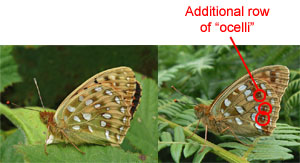
The Dark Green Fritillary and High Brown Fritillary are most easily distinguished by their undersides, since only the High Brown Fritillary has a row of "ocelli" just inside the outer margin. In addition, as the name suggests, the High Brown Fritillary has a predominately brown hue to the underside, whereas the Dark Green Fritillary is predominately green.


Dark Green Fritillary (left) and High Brown Fritillary (right)


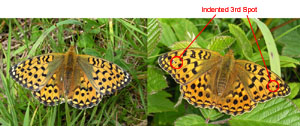
It is much more difficult to distinguish the Dark Green Fritillary from the High Brown Fritillary based on their uppersides. However, the first row of dots from the outside edge of the forewing upperside do give a clue - the 3rd dot from the apex of the forewing is in line with the other dots in the Dark Green Fritillary, but indented toward the body in the High Brown Fritillary.


Dark Green Fritillary (left) and High Brown Fritillary (right)


Armed with these sort of details we expected to be able to identify the High Browns easily. In practice the butterflies were so active that we struggled to even get shots of the upper wings. Still, here we go , starting with the easy bit first.


Dark Green Fritillary - no ocelli showing


High Brown Fritillary - with additional row of ocelli


High Brown Fritillary
- but not showing much of an indent on upperwing spot three


Dark Green Fritillary - no indent towards body on spot three


High Brown Fritillary - showing third spot indented


High Brown Fritillary


The High Browns are also supposed to show a slightly concave outside edge to their forewing whilst the Dark Green has a more rounded profile. You can see this on some specimens but on others and dependant on the camera angle it gets more confusing.


High Brown ?


You then have the problem of individual variations. This last picture looks like a High Brown but I did not see the under wing and cannot be sure. I also wondered about hybrids between the two species but cannot find any references to these on the web. If you want to be one hundred percent sure you really need to see the underside.

There were also some tatty specimens of Small Pearl-bordered Fritillaries flying and lots of Green Hairstreaks.


Green Hairstreak

A few Painted Ladies looking very worn but perhaps the start of a big influx.


Painted Lady

and a single Golden-ringed Dragonfly


Golden-ringed Dragonfly


It was a long way to go but it was a great day out. I am going to need one or two trips to Scotland to finish off the set.


Tuesday, 15 July 2014

Grayling


Butterflying has one big advantage over birding, if you do your research and get your timing right the butterflies will be there. That doesn't always happen with the birds. I think our only real failure this year has been in searching for Small Pearl-bordered Fritillaries in Sussex where three trips to Park Corner Heath have left me without a result.

Monday saw us out again, this time at Windover Hill looking for Grayling. I didn't really know what to expect. I had never seen a Grayling before and their cryptic camouflage is supposed to make them difficult to find. That was the case when we first arrived on the hill. We found Marbled Whites, Wall, and Small Coppers, along with the usual suspects but no Grayling.


Rather tatty Wall on a cow pat 


This one in better condition but not giving open wing shots


Whilst searching for the Grayling we also found a few moths including a freshly emerged Oak Egger and a Yellow Pearl mecyna flavalis. The latter is a rarity in Sussex although it seems quiet common on Windover Hill where there is reported to be a colony of them.


Oak Egger - freshly emerges and still blowing up its wings


Oak Egger


Yellow Pearl mecyna flavalis


This was our first visit to Windover Hill. It looks to be a great site for butterflies but we were beginning to think that we had come a week too early. Fortunately Dave had wandered off in pursuit of a Small Copper and I was soon chasing after him when he found our first Grayling of the day. There was the usual scramble to make sure we both had a record shot but then when we looked around it was clear that there were a good number flying. We counted five in the air at the same time but that was just in the one small location. Over the side of the hill there must have been at least twenty.


Grayling showing cryptic camouflage


 The Grayling tended to land on bare earth and broken rock where the camouflage was very effective but this did not make for a good picture. In fact it proved very difficult to get any distance between the Grayling and its background. An out of focus plain green background would have shown the detail much more effectively but I guess you can't have everything - at least not this time.


The eye pops up as a defence response


They nearly always settle with the wings closed


Then just as we were starting to get a bit bored we came across a mating pair and a few more pictures were taken.


Mating pair


Tuesday and we were hoping to repeat our success by finding a Silver-spotted Skipper. This was another new location, Newtimber Hill, and for me another new butterfly. The search was a partial success. Dave found the skipper and managed to take a photograph. I did get to see it but just as I pressed the shutter button for my record shot it took off. It moved with surprising speed for a Skipper, we didn't see it go and we could not relocate it despite a couple of hours of looking. So if you want to see a picture of the Silver-spotted Skipper you will have to look at Dave's blog site.                                                                          

We had regular visits from a Small Copper whilst we were looking. This was showing blue spots on its rear wings and is of the form caeruleopunctata  or should it be referred to as an ab. caeruleopunctata?   The books do not seem to be clear on the difference between an aberration (ab) and a "form". At the moment I am taking it that they are both caused by the same triggers but an aberration is a variation that is a rarity whilst a form is a variation that is consistent and common.   If you are interested read more about it here.                                                                                                                    

                                                                     
Small Copper ab. caeruleopunctata


Small Copper


Peacock


We made a quick trip to Chantry Hill in the afternoon. There were a lot of Dark Green Fritillaries  on the track between the car park and the hill but most of these were in poor condition. There were also a good number of Marbled Whites and these looked surprisingly fresh.

It was a hot day and I was beginning to feel tired but then I spotted a pair of mating Dark Green Fritillaries. I only managed one quick shot before they took off and disappeared down the hill.


Mating Dark Green Fritillaries


There was clearly a good shot to be had here and I was quickly off in pursuit. I did manage to catch up once about half way down the hill but they were flying again almost as soon as I got to them. By the time I got to the bottom of the hill they had disappeared altogether. It was only then that it dawned on me that I had to climb all the way back up and it's a big hill. Butterflying can be hard work.


Sunday, 22 June 2014

Dark Green Fritillary


Whilst out walking over Seaford Head with friends on Sunday we came across two or three Dark Green Fritillaries. Lunch and a couple of pints were waiting at the now renovated and renamed Golden Galleon so I did not have much time for pictures. However, this was my first sighting of the Dark Greens this year so I was not going to let it pass without recording the sighting.


Female Dark Green Fritillary


The male was a bit more mobile and harder to photograph.


Male Dark Green Fritillary


Good, but the job is only half done. I need to get a closed wing shot or at least some record of the under wing.

The birding is getting a bit sidelined at the moment. I will get back to it but the window for seeing some of these butterflies is very narrow and I need to get those in the bag first. Purple Emperor and Hairstreaks next - I hope.