Showing posts with label Golden-ringed Dragonfly. Show all posts

Wednesday, 26 June 2019

Golden-ringed Dragonfly


With the recent focus on Orchids my bird list for the year is looking a little sad. I am around thirty to forty birds behind the norm and missing a good few of the common species. Thinking I would fill a few of the gaps I headed over to Iping Common today.

There are never a lot of birds on the commons but you do pick up a few of the scarcer species. Woodlark and Redstart were welcome finds but there was no sign of any Tree Pipits which I had also hoped to see. Both birds seen were distant views with only poor record shots obtained.

There were good numbers of butterflies around but most were hyperactive in the hot sun. Silver-studded Blues, in particular, are always good to see but I am still waiting to capture photographs of the ants tending the newly emerged butterfly.


Males are easy to see but don't stay still for very long. Females are less conspicuous and tend to hide away in the vegetation. You can see why. If you do find a female you only have a few seconds to get a picture before the amorous male turns up.


Female Silver-studded Blue


Male in attendance


He didn't have much luck. She took one look and headed straight for deep cover.


There has been an influx of Painted Ladies from the continent with appearances almost everywhere. Unfortunately most look as though they have flown all the way from North Africa and are not in best condition. There should be time for a second brood which will emerge later in the year and we may get good numbers of pristine butterflies which will be well worth seeking out.


Painted Lady


There is always a chance of finding a Golden-ringed Dragonfly on the commons and if you find one that's in the middle of having its lunch it may even stay still long enough for a picture.


Golden-ringed Dragonfly and unfortunate hoverfly


Golden-ringed Dragonfly


And a freshly emerged Four-spotted Chaser. Just a pity about the busy background.


Four-spotted Chaser


Perhaps not the bird pictures that I had hoped for but still an interesting day


Sunday, 12 July 2015

Northern Brown Argus and Chequered Skipper


This is part two of our Scotland trip and covers some of the butterflies and moths that we found on our travels. There will also be a part three containing even more impressive butterflies.

Day one and our destination was the St Abbs Head National Nature Reserve to look for the Northern Brown Argus. A quick walk round to the butterfly reserve soon warmed us up but the air temperature was still a little on the cool side and the only butterflies flying were a few Ringlets and this small moth that I think is a Chimney Sweeper.

Chimney Sweeper

We started to have our doubts but a few minutes searching the target area and Dave came up with the first Northern Brown Argus.


It was a great start to the tour we had planned. We had probably only seen eight to ten Northern Browns by the time we left but we were keen to move on to our next destination and couldn't really wait for more to appear.

Close on three hours later and we were at our second site Trinafour, looking for the Mountain Ringlet, and despite a good search we came up empty handed. At the time we thought that the temperature was probably too low but by the end of the week having dipped the butterfly three times we came to the conclusion that we were probably a couple of weeks too early. Although, I have to admit, that we bottled out of climbing the hill to see if they were on the slopes above Glasdrum Wood.

Glasdrum gave us a Chequered Skipper which we had not been expecting. It was a bit tatty but who am I to complain. It looks as though both the Mountain Ringlets and Chequered Skippers are running a bit late this year.


Chequered Skipper - a bit past its best


There were also a lot of Small Pear-bordered Fritillaries along the way-leave at the bottom of the wood and what looked like a couple of Dark Green Fritillaries but the latter were flying too fast for us to follow over the boggy ground. Nice to see the Small Pearl-bordered as they now seem to be extinct in Sussex.


Small Pearl-bordered Fritillary


Another bonus in Glasdrum Wood were the Golden-ringed Dragonflies.


These were a couple of great locations, where we could really have done with spending a lot more time. I am sure Trinafour would also have been good, if we had just managed to get the timing right.

Part three covering the rest of the butterflies on the trip to follow.

Thursday, 18 June 2015

High Brown Fritillary


I am gradually filling in the gaps in my UK butterfly collection. On Monday I detoured to Collard Hill on a return journey from Wales. I didn't get there until about four thirty so did not have long to search for the Large Blue but I did get to see one. The record shot is really awful so I am not putting it up here but I was just happy to have seen it.

Today was a trip down to Aish Tor on Dartmoor in search of the High Brown Fritillary. A long day, seven hours of driving and about seven hours searching for butterflies, but at least the driving was shared with Dave. More importantly we did get to see the target butterfly.

It was hot and the butterflies were very active so finding one that would stay still long enough to get a picture was difficult. We also had the problem that the Dark Green Fritillary flies at the same site and from a top view they are difficult to tell apart. However if you can get a view of the underwing it is easy tell the difference between the two. I was going to try to explain this but in the end decided to lift this explanation from the UK Butterflies site.

UK Butterflies - Similar Species

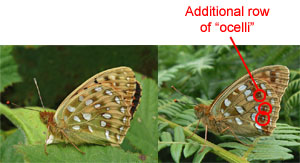
The Dark Green Fritillary and High Brown Fritillary are most easily distinguished by their undersides, since only the High Brown Fritillary has a row of "ocelli" just inside the outer margin. In addition, as the name suggests, the High Brown Fritillary has a predominately brown hue to the underside, whereas the Dark Green Fritillary is predominately green.


Dark Green Fritillary (left) and High Brown Fritillary (right)


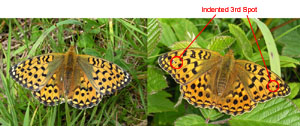
It is much more difficult to distinguish the Dark Green Fritillary from the High Brown Fritillary based on their uppersides. However, the first row of dots from the outside edge of the forewing upperside do give a clue - the 3rd dot from the apex of the forewing is in line with the other dots in the Dark Green Fritillary, but indented toward the body in the High Brown Fritillary.


Dark Green Fritillary (left) and High Brown Fritillary (right)


Armed with these sort of details we expected to be able to identify the High Browns easily. In practice the butterflies were so active that we struggled to even get shots of the upper wings. Still, here we go , starting with the easy bit first.


Dark Green Fritillary - no ocelli showing


High Brown Fritillary - with additional row of ocelli


High Brown Fritillary
- but not showing much of an indent on upperwing spot three


Dark Green Fritillary - no indent towards body on spot three


High Brown Fritillary - showing third spot indented


High Brown Fritillary


The High Browns are also supposed to show a slightly concave outside edge to their forewing whilst the Dark Green has a more rounded profile. You can see this on some specimens but on others and dependant on the camera angle it gets more confusing.


High Brown ?


You then have the problem of individual variations. This last picture looks like a High Brown but I did not see the under wing and cannot be sure. I also wondered about hybrids between the two species but cannot find any references to these on the web. If you want to be one hundred percent sure you really need to see the underside.

There were also some tatty specimens of Small Pearl-bordered Fritillaries flying and lots of Green Hairstreaks.


Green Hairstreak

A few Painted Ladies looking very worn but perhaps the start of a big influx.


Painted Lady

and a single Golden-ringed Dragonfly


Golden-ringed Dragonfly


It was a long way to go but it was a great day out. I am going to need one or two trips to Scotland to finish off the set.


Tuesday, 10 June 2014

Silver-studded Blue


We started the day off with a visit to Botany Bay Wood, just over the border into Surrey, to see if we could get Dave a Wood White. It was all a bit quiet when we got there but I think we were just a bit too early in the day. Eventually we found a couple and Dave got his pictures and a year tick.


Wood White


Wood White


It's difficult to see why there are so few colonies of Wood Whites around. They seem to have a wide range of nectaring and food plants and are not particularly temperature or geology sensitive. I know that we have lost a lot of coppiced woodland rides which will affect their numbers but there are many woods similar to Botany Bay across the south of England.

Our next stop was Iping Common where Silver-studded Blues had been reported. Its a small butterfly on a large common but we eventually found a small group. There were probably two or three females and and about eight males. I have had trouble photographing Silver-studded Blues in the past. Closed wing shots are not a problem but they often sit with their wings open at forty five degrees and it is very difficult to get the depth of field you need to get the whole butterfly sharp - that's my excuse anyway.


Note the silver studding in the black marginal spots


Female - colours vary from dark brown through to predominantly blue
This female is only a couple of days old and has not faded to this state.


Male


Wood White and Silver-studded Blue in the bag and we still had most of the afternoon left. A large moth distracted us for a few minutes on the way back to the car park. I had to look it up in the book when I got home, it was a Clouded Buff.


Clouded Buff  - day flying moth


We decided on a visit to Lords Piece on the way home to have a look for Dragonflies. It turned out to be a good choice. There were plenty of Blue Damselflies around the pond but they were not easy to photograph.


I think this one is an Azure Blue


We saw Four-spotted and Broad-bodied Chasers but best of all were views of a Golden-ringed Dragonfly and a Downy Emerald. Both landed and gave us long enough to get a few pictures.


Broad-bodied Chaser


Four-spotted Chaser


Downy Emerald


Golden-ringed (Female)


The only problem with a good day out is that you have hundreds of pictures to process when you get home. They are never as good as you want or expect but you just hope for a couple of good ones in there somewhere.